The Great Sphinx of Giza, or the Egyptian Sphinx
- Main
- >
- Egyptian Mythology
- >
- Egyptian Myths and Legends
- >
- The Great Sphinx of Giza
 The Great Sphinx of Giza
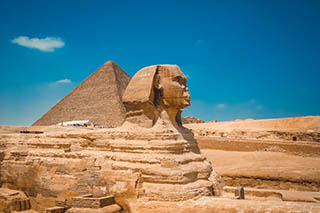
The Great Sphinx of Giza, or the Egyptian Sphinx, is the largest and oldest monumental statue ever carved by human hands from a single block of limestone — one of the wonders of the ancient world that survives to this day. It takes the form of a mythical creature with the body of a lion and the head of a man, and stands as a symbol of wisdom, might, dignity, strength, and power, as well as a superhuman embodiment of the pharaoh. It is also considered the guardian of the House of the Gods.
Most historians believe the Great Sphinx was built around 2550 BCE, during the reign of Pharaoh Khafre, and that it bears his face. Other researchers, however, believe the Sphinx already stood by that time, making it far older still. One theory suggests it may have been built as early as 12,000 BCE, an idea supported by the alignment of the pyramids with the stars of the constellation Orion.
One of the names the ancient Egyptians gave the Great Sphinx was Harmachis, or Hor-em-Akhet, meaning "Horus on the Horizon." Harmachis was considered one of the manifestations of the god Horus, and a guardian watching over the House of the Gods. Medieval Arabs called it "the Father of Terror" or "the Terrifying One," believing that its powerful presence rendered people silent. They also avoided speaking of it, regarding the Sphinx as an extraordinary pagan symbol that had stood long before the birth of Christ — at once a terrifying and magnificent watcher, gazing on unceasingly across the millennia.
 The Egyptian Sphinx
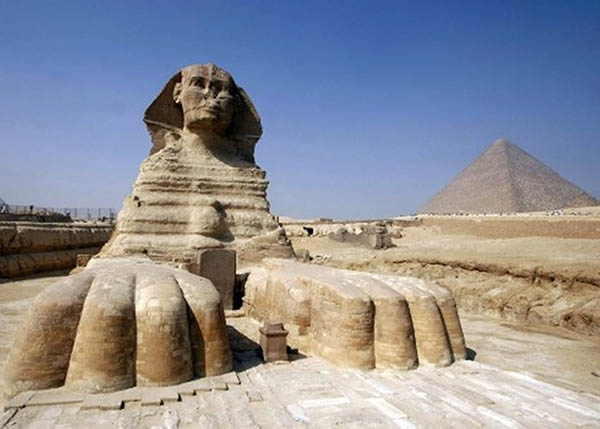
It's believed that the Sphinx guards the pyramids standing behind it, but below lies a temple with its own hidden underground structures — and perhaps it is this unfinished temple that is the Sphinx's true charge, the one it watches over so vigilantly.
There is a theory that an entrance to a labyrinth lies between the statue's paws, its correct path known only to the priests. Inside stand bronze doors leading to the mysterious World of the Pyramids, behind which lies hidden the key to the wisdom of the gods — and perhaps even an entrance to the afterlife.
The statue has been buried in sand many times throughout its history, occasionally staying hidden for entire centuries. There's even a myth that when the Sphinx is displeased with how it is treated, or with the current government, it rises and walks off into the desert, burying itself deep in the sand. But just as many times as it was buried, it has been dug back out. Standing between the Sphinx's paws is the granite Dream Stele, which recounts one such excavation carried out during the reign of Thutmose IV.
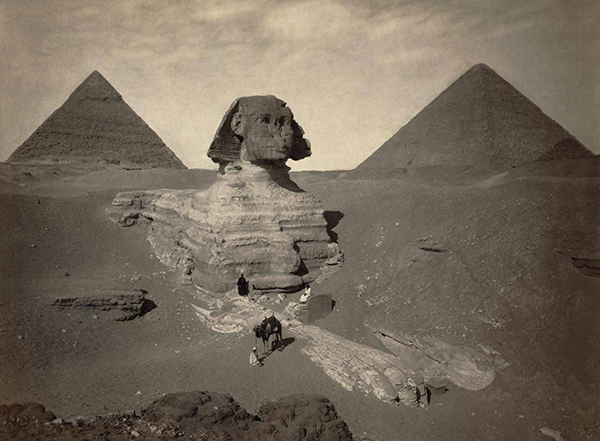 The Great Sphinx buried in sand
Around 1400 BCE, an Egyptian prince set out hunting with his servants. He hunted all morning, and only at midday allowed his men to rest, while he himself offered flower seeds to the god Horus before returning to his servants. As it happened, the prince took shelter from the merciless sun in the shade of the sand-buried Sphinx. There, in a dream, the sun god — who was then depicted in the form of the Sphinx — came to him and declared that if the prince cleared the Great Sphinx of sand, he would prove himself the god's son and helper, and would in time ascend to the throne. The prince did indeed later take the throne, although he had not been expected to. Remembering the god's words from his dream, he had the statue dug out. And so the prince became Pharaoh Thutmose IV.
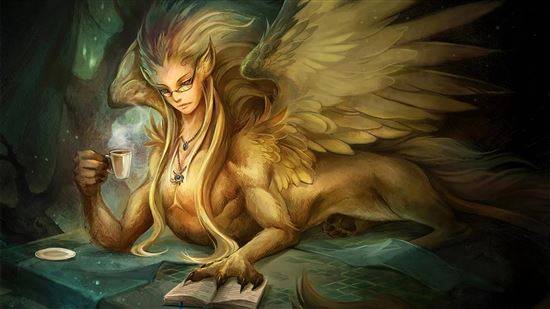 The Sphinx, a symbol of knowledge and truth
In ancient Egypt, the Sphinx was a symbol of the pursuit of truth, as well as a living image of the ruler. It was respected and not feared as a monster at all — quite the opposite, it was revered as a protector of the pharaoh's authority. Only much closer to our own era, under the influence of Greek myths and other religions, did people begin to fear it — perhaps because of the immense strength and power it had radiated for thousands of years.
The Great Sphinx measures 72 meters in length and 20 meters in height. For most of its existence, it lay buried in sand and was excavated numerous times, most recently about 100 years ago, in the 1920s–1930s. Traces of red paint remain on its head, indicating that it was once painted. There is also a hole that was initially thought to be a secret entrance, but this was later disproven — it turned out to be a mounting point for a headdress that was lost during a powerful storm. The Sphinx also once had a beard, which was removed due to erosion and is now kept in the British Museum.
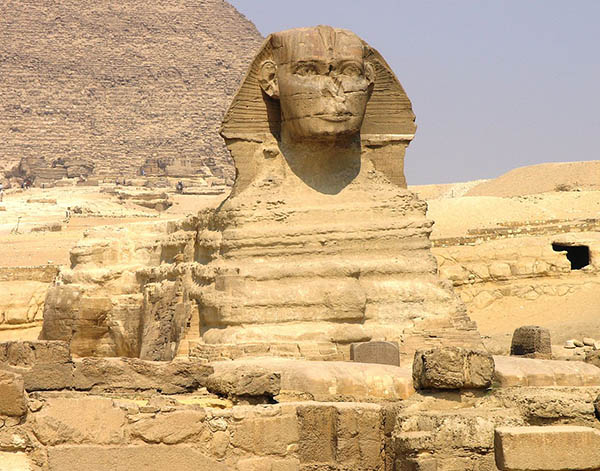 The Sphinx's nose
For a long time, Napoleon Bonaparte was blamed for the statue's missing nose. It was believed that a cannonball struck the nose during his war against the Ottomans. But illustrations exist that predate this event and already show the nose missing.
Another version, from a Cairo-based historian, claims that a Sufi fanatic did it, enraged upon seeing Egyptians bringing offerings to the Sphinx. This contradicted his faith, so he broke off the statue's nose — and was severely punished for it by the local population. Most historians and scholars lean toward this version.
A third version attributes it to simple erosion. Thousands of years ago, Egypt's climate was entirely different, with frequent rainfall. Supporting this theory are the horizontal grooves recorded encircling the statue along its entire perimeter.
The Great Sphinx is unquestionably the largest of the world's oldest sculptures. However, there are smaller sculptures that predate it — and interestingly, they too were carved in the shape of a sphinx.
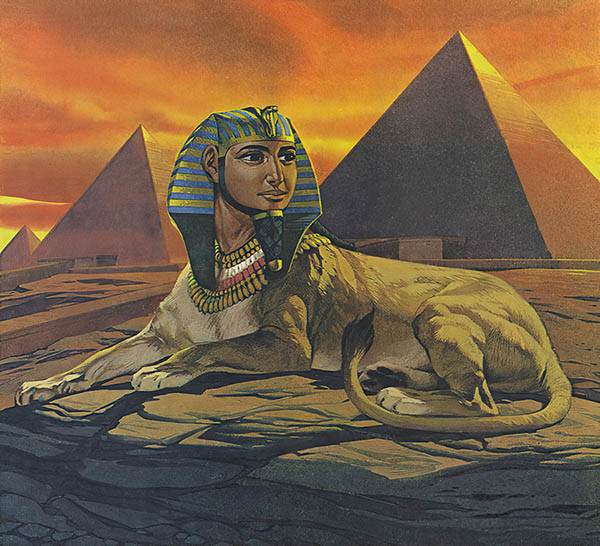 The Great Sphinx of Giza
For more than five thousand years, the Sphinx has watched the sun god Ra rise in the distance over the Nile. Each day, the sun's rays touch its face first, before spreading across the rest of Egypt. It has witnessed the birth of Egypt's history, watched pharaoh after pharaoh come and go, serving as their companion and sentinel. And in its own way, it remains the pharaoh who built it, having found immortality in its form. It has been given countless names by people over the ages, and may yet be given more. But regardless, it will continue to stand — standing there, greeting the sun's first rays each and every day…
Related Articles