Sphinx — a Mythical Creature in Greek Mythology
- Main
- >
- Greek Mythology
- >
- Greek Bestiary
- >
- Sphinx
 Sphinx
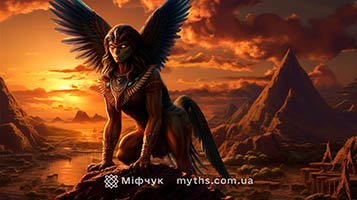
The Sphinx is a mythical creature in Greek mythology. This monster had the wings of an eagle, the body of a lion, and the breasts and face of a woman, and was one of the many offspring of Typhon and Echidna. It embodied inhuman torment and inescapable fate. The Sphinx was famed for its riddles, and its name in Greek derives from the word "to strangle."
In one of the many versions of the Sphinx legend, the monster settled on a mountain near the city of Thebes. To everyone who crossed its path, the Sphinx posed a riddle: "What walks on four legs in the morning, two at midday, and three in the evening?" A wrong answer meant certain death in the monster's jaws. Among its victims was even Haemon, son of King Creon. The king swore to give his kingdom and the hand of his sister Jocasta to whoever defeated the Sphinx. Oedipus solved the riddle, answering that it was a human being in infancy, adulthood, and old age. After this, the monster threw itself from the cliff and died.
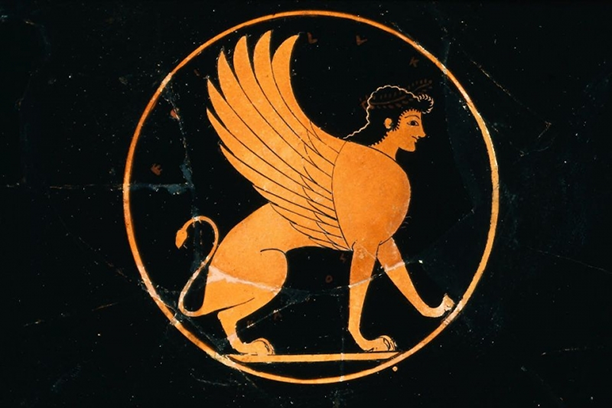 Sphinx on amphorae
Behind this main legend of the Sphinx lies an even older one — about a monster on Mount Phicium. She was called Phix, and her parents were Orthrus and Echidna. She was described as extremely fierce, bloodthirsty, and one who swallowed her prey whole, her appearance derived from a lioness-like creature common in Asia Minor. In this version of the legend, Oedipus defeated the monster in a brutal fight.
In ancient Greek culture, the earliest mentions of sphinxes date to 1600 BCE. During this period, the monster acquired its distinctive features, different from the Egyptian version — wings and a woman's face. After 1200 BCE, mentions of the creature curiously vanish for 400 years, then return and become popular again all the way up to the 6th century. Depictions of the Sphinx were widely used in various forms of art and in objects made of ivory and metal.
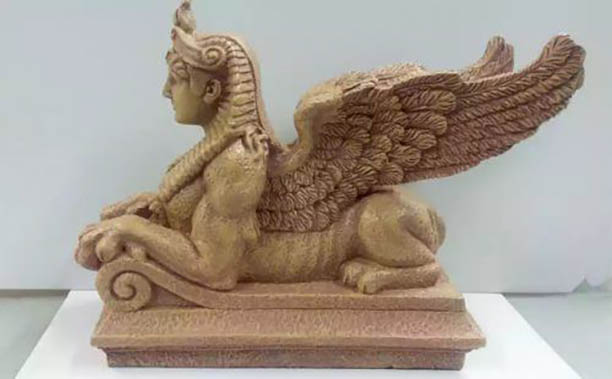 Sphinx statuette
Besides the previous riddle, various interpretations included another version: "There are two sisters: the first gives birth to the second, and the second then gives birth to the first. Who are these two sisters?" There is speculation that this version of the riddle is older, and that the correct answer to it is "day and night."
Incidentally, tales of the Sphinx are always accompanied by riddles, and this made the creature a symbol of mystery and helped popularize it among the wider public. Its image was even used by the Freemasons to emphasize their own secrecy and mystique.
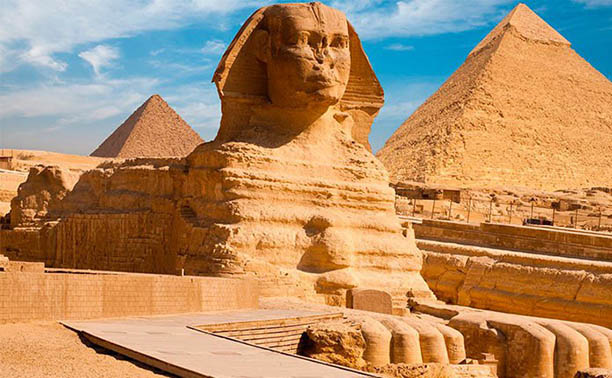 The Great Sphinx
Most people assume that the architectural monument known as the Great Sphinx was named by the Egyptians, but in fact it was the Greeks who did so, linking it to the figures of their own legends. The Egyptians called this statue "Harmachis." It represents one of the aspects of the god Horus, connected to the cult of the sun and to a guardian who watches over the House of the Gods.
We will take a closer look at the Egyptian sphinx in a future article.
Related Articles