
The Myth of Pomona and Vertumnus, Roman Mythology
- Main
- >
- Roman Mythology
- >
- Roman Myths and Legends
- >
- The Myth of Pomona and Vertumnus
 Pomona and Vertumnus
Vertumnus is the Roman god of change and transformation, who governed above all the changing of the seasons and the transformation of plants from blossom to fruit, as well as the cultivation of gardens and orchards. He had the ability to change his own appearance at will.
Pomona was a beautiful nymph who specialized in growing and tending fruit trees. She was the guardian of fruitful abundance and embodied the very essence of the blossoming of fruit trees. She was usually depicted holding ripe, juicy fruit or a cornucopia.
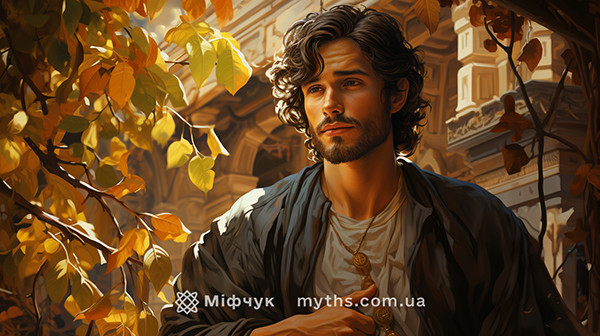 the Roman god Vertumnus
Pomona was pursued by many gods and admirers because of her extraordinary beauty. But she ignored them all, remaining devoted only to her work — the tending of her orchard, which she allowed no one to enter.
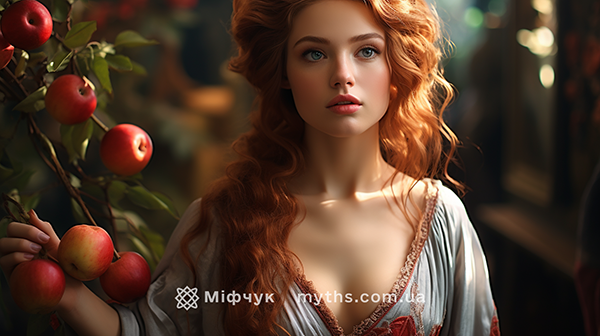 the beautiful nymph Pomona
Vertumnus, too, fell madly in love with the nymph, but could never manage to win her favor. He resorted to countless tricks and transformations, becoming now a vine-dresser, now a fisherman, now a soldier. Finally, he came to her in the guise of an old woman, and began, through examples and tales, to press upon her the idea of marriage.
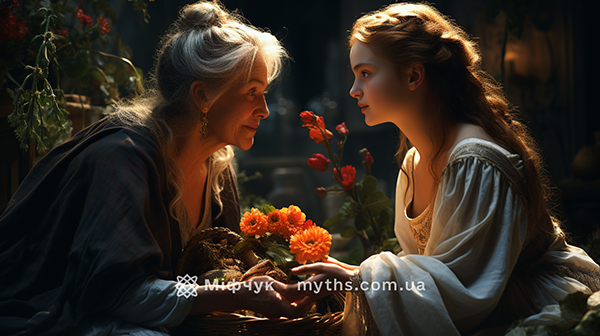 The old woman and Pomona
The "old woman" drew Pomona's attention to a grapevine wound around the trunk of a tree, pointing out that if the vine stood alone, it would have nothing to lean upon or climb. It could never grow so tall or bear such beautiful, juicy fruit, and would instead lie upon the ground in complete solitude. So it is important, she said, to have support, and someone reliable at your side whom you can trust and always rely upon.
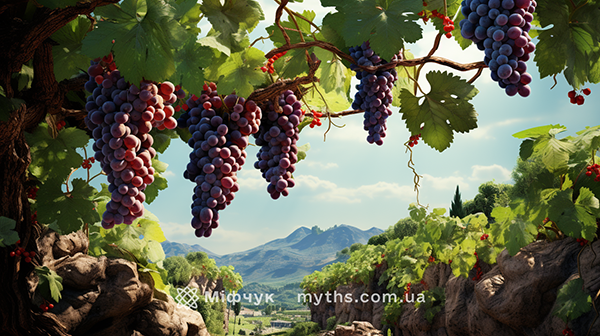 Grapes in the garden
The "old woman" then went on to scold Pomona for working alone and refusing to marry — for failing to follow the example of this very grapevine she tended so carefully. She reminded her of her many admirers, and of one among them in particular: a young and handsome god, hopelessly in love with her, who, unlike the others, would never wander the world afterward, would never be unfaithful, and would remain forever true. For his heart belonged to only one woman in the entire world, and that beautiful woman was Pomona.
 Iphis
IphisVertumnus, still disguised as the old woman, then began to tell the following legend. A noblewoman named Anaxarete was loved beyond reason by a young man, Iphis, of lower birth. And though reason told him this love could never be fulfilled, his heart would not let her go. The young man tried every means to win her favor. He sent passionate letters, tried to approach her through her servants, showered her with gifts, and at last came to her in tears, begging for mercy. But the girl always cruelly turned him away. Worse still, she mocked and insulted the young man out of spite.
 Anaxarete
Iphis grew weary of a life without requited love. And so he resolved to end it — but in such a way that Anaxarete herself would witness it, and so he did it in her very chambers, before his beloved's own eyes. Iphis's mother wept bitterly for the son she had raised without a father. The funeral procession made its way through the entire city. Anaxarete wished to watch it pass from her window. But the moment she saw the young man's body, she turned into a statue of stone. That statue still stands in Cyprus to this day.
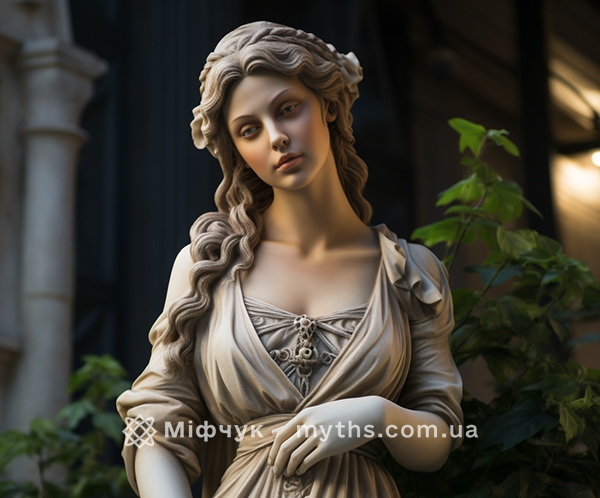 Statue of Anaxarete
The "old woman" finished her tale, and then asked Pomona not to forget this example of the grapevine, nor the sorrowful story of unrequited love. She urged her to set aside her pride and unite with the one who loved her.
 Pomona and Vertumnus
And she added that if Pomona did so, no spring frost would ever harm the buds of her fruit, and no fierce wind would ever tear the blossoms from her garden. Then the god cast off the old woman's rags and rose before Pomona in his true and unclothed form. The nymph realized at last how wise Vertumnus had been, how deeply he loved her, and saw, too, how handsome he was besides. And at last, love took root in her own heart, and their hearts began to beat as one.
The lovers married and lived happily. They tended the trees in Vertumnus's garden, which became the most beautiful and wondrous garden in the entire world. And together, as a couple, along with their garden, they grew more beautiful with every passing year.
Related Articles