Gaia — the Goddess of the Earth in Greek Mythology
- Main
- >
- Greek Mythology
- >
- Greek Pantheons of the Gods
- >
- Gaia
 Gaia
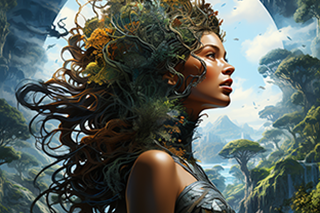
GaiaGaia is the goddess of the Earth in Greek mythology, also worshipped as a goddess of fertility. She was considered the primordial mother of all living things, since all other life was born from her.
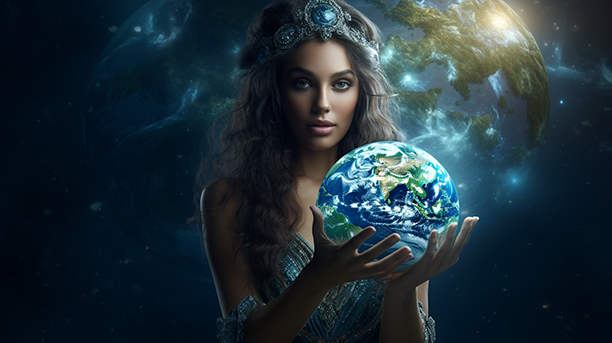
According to Hesiod's "Theogony" (8th–7th century BCE), in the beginning there was only boundless space, known as Chaos. From it arose the first goddess, Gaia — the most ancient ancestor of the Greek gods. Alongside her arose Tartarus (the underworld) and Eros (love). Then, through her power to create life, Gaia gave birth to Uranus, the god of the sky, Pontus, the god of the sea, and the mountains, the Ourea.
Gaia was considered not only the first goddess, but also the primordial prophetess. Mother Earth was worshipped at Delphi. There stood the most ancient religious center and the Delphic oracle of Gaia, which proclaimed the goddess's will. The oracle was guarded by the serpent Python, and because of this the place was called Pytho, and the prophetess was called the Pythia. At first, young maidens were chosen to serve as the oracle (Pythia), and later, women of noble birth. The gift of prophecy belonged uniquely to women and goddesses, until the god Apollo eventually displaced Gaia and became the god of prophecy himself — though even then he shared this role with his sister Hecate. Gaia's connection to prophecy appears in many legends. For example, it was through Gaia's prophecy, which foretold that Cronus would meet the same fate as his own father, that Cronus began swallowing all of his children.
 Gaia was considered the first goddess
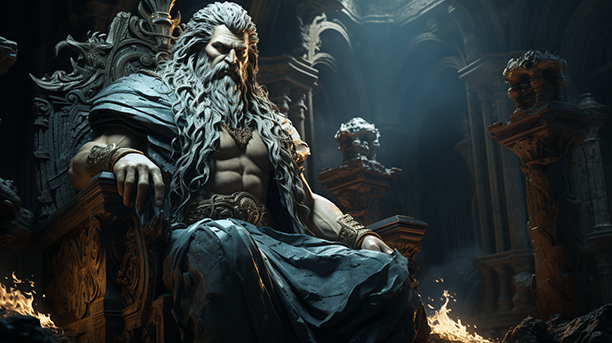
Later, Mother Gaia took Uranus as her husband, who showered her with fertile rain, and from their union were born twelve mighty Titans and Titanesses (Oceanus, Coeus, Crius, Hyperion, Iapetus, Cronus, Theia, Rhea, Themis, Mnemosyne, Phoebe, Tethys, and Dione). Gaia also bore the first three one-eyed giants, the Cyclopes, and the three Hecatoncheires, each of whom had 100 arms and 50 heads. Their children were tall, mighty, and monstrous, which frightened Uranus, who feared such offspring might threaten his rule. He imprisoned them in the underworld of Tartarus, where they never saw the light of day. Gaia grieved for her children and suffered physically as well — it was agonizing to hold so many monsters within her depths.
 Uranus
And so Gaia devised a plan to overthrow Uranus's rule, but no matter how she tried to convince her children to rise up against their father, none of them dared. Finally, the youngest, most ruthless, and boldest of them, the Titan Cronus, agreed to support his mother. Gaia forged an adamantine sickle and gave it to her son. When Uranus came down to Gaia that evening, Cronus emerged from his hiding place, attacked, and cut off his father's genitals with the sickle. From the blood that Uranus spilled onto the Earth arose the Erinyes (the Furies), goddesses of vengeance, the Meliae, nymphs of the ash trees, and the Giants. And when Cronus cast his father's severed genitals into the sea, from the sea foam mingled with Uranus's blood arose the goddess Aphrodite.
Cronus took his father's throne, but to Gaia's great disappointment, he left her other children imprisoned in Tartarus, and even set the poison-spitting monster Campe to guard them.
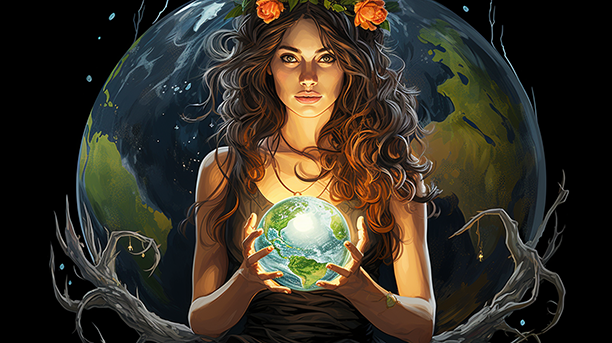
Gaia was worshipped in Athens, Sparta, and Dodona, and was part of the cult of the goddess Demeter, though many rituals were also dedicated to her separately. For example, black animals were sacrificed to Gaia, since the color black was associated with the Earth, while white animals were reserved for the gods of the sky.
 Gaia was worshipped in Athens
Gaia was worshipped under many different names: she was called Anesidora, meaning "giver of gifts," Kalligeneia, "fair of birth," and Eurysternos, "the broad-bosomed goddess" — perhaps reflecting the Greeks' belief at the time that the earth was shaped like a disk surrounded by the sea. Gaia was also considered a protector of children, hence her further epithet Kourotrophos, meaning "nurturer, nurse." On surviving ancient Greek sculptures and vases, the goddess Gaia is depicted in various ways: as a beautiful woman surrounded by children and animals, holding a cornucopia, or as a woman whose lower body remains beneath the earth. A frieze from the Pergamon Altar has also survived from antiquity, depicting the battle between the Olympian gods and the Giants. Gaia is shown with her arms raised and her long hair falling loose. The sculptor managed to capture the grief of Mother Earth, whose children were killing one another.
Related Articles