Thoth — the God of the Moon, Time, Wisdom, Magic, and Writing in Egyptian Mythology
- Main
- >
- Egyptian Mythology
- >
- Egyptian Pantheon of the Gods
- >
- Thoth
 Thoth
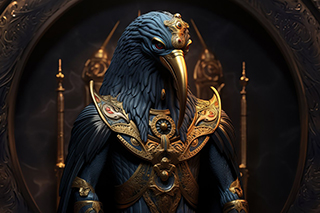
ThothThoth is the god of the moon, time, wisdom, magic, and writing in Egyptian mythology. He was depicted as a man with the head of an ibis, though sometimes also as a baboon with a lunar disk on his head. Maat, the goddess of truth and order, was considered his wife.
One of the strangest myths about Thoth concerns his birth. According to it, this happened during the fierce conflict between Set and Horus. Horus mixed his own seed into Set's favorite dish — lettuce. The god of evil failed to notice and ate it, after which Horus's seed gathered on Set's forehead and gave birth to Thoth. This birth was deeply symbolic for Thoth, representing the emergence of light from darkness, of good from evil — marking Thoth as the god of the moon, who brings light in the night.
 The first night
Another myth about his origin tells that he was born from the mouth of the god Ra. This likely refers to the myth in which Ra, during the creation of the world, spoke the names of the gods, and they were born by his word. In addition to this, Thoth himself appears as a creator of the universe, though he is most often credited with inventing many human sciences and professions.
The earliest accounts claim that Thoth was originally the left eye of the god Horus, which Set damaged in battle. By the Old Kingdom period, Thoth had already developed into a distinct god and began to be worshipped in the city of Eshmunein. And when Hermopolis (a center of sun worship) began to play an important role in Egyptian politics, Thoth became extremely popular.
Beyond all this, he was considered the inventor of writing, patron of the sciences, of scribes and sacred books, and held the roles of scribe, vizier, and secretary within the Egyptian pantheon. He taught the Egyptians writing, mathematics, medicine, magic, and many other sciences. All archives and libraries fell under his protection, especially in Hermopolis, the center of Thoth's cult. He was also described as the god who governs all languages, and was himself considered to be the tongue of Ptah.
 Ibises
Ibises arrived in spring, during the flooding of the Nile, so Thoth was also associated with the spring awakening of nature. This is described in a myth in which he brings Tefnut back to Egypt, and nature blossoms as a result. Besides the ibis, Thoth is also associated with baboons, whose image the Egyptians saw reflected in the moon — which is why Thoth was sometimes depicted as a baboon with a lunar disk on his head. Ibises and baboons served as Thoth's messengers.
Thoth is likened to the moon and is depicted behind Ra. At night, Thoth served as his loyal stand-in. According to legend, Ra once grew tired of forever shining upon humanity and watching over their squabbles, so he asked Thoth to take his place, granting him a portion of his power. Ra descended into the underworld to rest, and Thoth rose in his place. Thus night fell for the first time, and with it rose the moon, giving people light in the darkness.
Thoth is sometimes called the "Lord of Time," because he created the calendar and divided it into years, months, and days. But this calendar was imperfect and was tied to the flooding of the Nile, which occurred every year at roughly the same time — July 20th. Alongside this, the star Sotis (Sirius) would rise early in the morning, becoming another marker for the start of the new year. Under this calendar, the year lasted 365 days, but the Egyptians failed to account for the fact that a year actually lasts 365.24 days — so within just four years, their calendar had already drifted out of sync with nature. This problem was later solved by the Romans through the introduction of leap years.
 Thoth, Lord of Time
At the judgment of Osiris, Thoth, together with Anubis, played one of the most important roles. He served as scribe and vizier, overseeing the weighing of the deceased's soul and recording the results. Beyond this, Thoth took part in the funerary rites of every Egyptian and accompanied them after death. He also kept chronicles, and recorded the dates of people's births and deaths.
Thoth was considered wise not only by humans, but by the gods as well. He often served as an arbiter, intervening in disputes among the gods. He could resolve conflicts even between the fiercest of enemies, such as Horus and Set, who embodied absolute opposites of one another. He also watched over the balance of power, and in this matter he showed no favoritism — he aided the forces of good and evil alike.
But at times, Thoth's great intellect turned into endless remarks, corrections, and lectures that greatly irritated the other gods, who often found it unbearable. For instance, when Isis's son Horus once fell ill, she came to Thoth for advice — but he became so caught up in tedious deliberation that the goddess couldn't take it anymore and said: "Thoth, how wise is your heart, yet how slow are your decisions!"
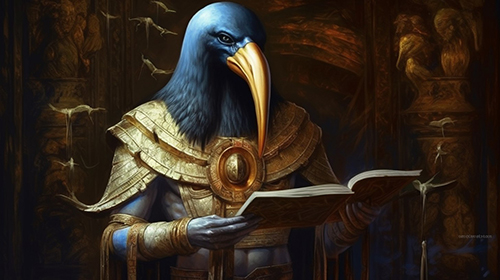 Thoth's symbolism: books
Thoth's symbolism was highly varied. Besides the ibis and the baboon, there were, of course, books. The god was depicted with scrolls, texts, and other writing instruments, reflecting his connection to all forms of knowledge. He was also associated with staffs and the ankh symbol, representing his power over magic and healing.
The god Thoth always played a deeply important role for the Egyptians. He was tied to the spread and advancement of writing and many sciences, and was honored within the funerary cult, where he held one of the most important places. He preserved balance and equilibrium in every aspect of life, both among ordinary people and among the gods. It's no surprise, then, that he remained popular for thousands of years, and — most importantly — continually evolved and grew alongside humanity. He was their true guide toward the future, thereby becoming, in his own right, a creator — the creator of what was yet to come.
Related Articles