Hathor — the Egyptian Goddess of Love
- Main
- >
- Egyptian Mythology
- >
- Egyptian Pantheon of the Gods
- >
- Hathor
 Hathor
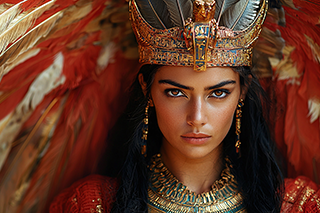
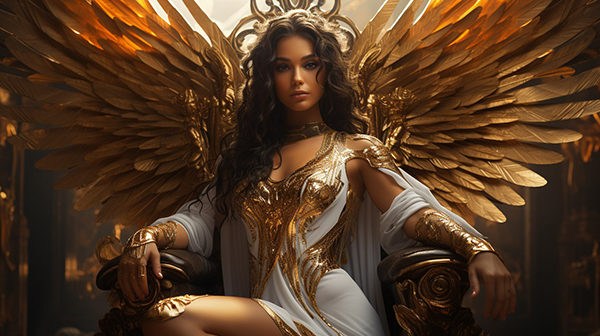
Hathor is the Egyptian goddess of love, beauty, music, dance, joy, motherhood and fertility, the night sky and stars, mines and miners, and forests, as well as the protector of people and patroness of the pharaohs. She was depicted as a celestial cow who gave birth to the sun, or as a beautiful woman with horns and a solar disk upon her head.
When Ra created the world, the gods, and everything around them, he descended to humanity and became the first pharaoh — but in doing so, he slowly began to lose his strength and grow old. He ruled Egypt for thousands of years this way, but when he had grown very weak, ungrateful humans rose up against him. Hathor, considered his daughter, grew furious, transformed into the lioness Sekhmet, and began mercilessly slaughtering people. This horrified not only humans but the gods as well, and to prevent the annihilation of humanity, they dyed beer red and poured it out onto the sand. Sekhmet, mistaking it for blood, drank it all. Growing drunk, she calmed down and once again became the gentle Hathor.
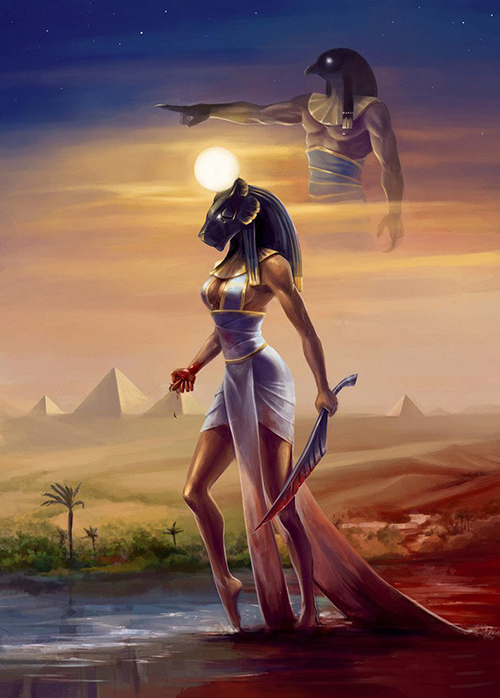 Sekhmet
Hathor was originally considered a daughter of Ra, and later came to symbolize the Eye of Ra. In most accounts, she was the wife of Horus, and was also identified with the cow that gave birth to the sun. As the cow was a sacred animal to the Egyptians, Hathor was worshipped throughout all of Egypt, especially in the city of Dendera, the center of her cult, where she was even called the Mistress of Dendera. The Egyptians also frequently identified the goddess with the Milky Way.
Every night, Hathor descended into the underworld, where the righteous dead could count on her protection and help. This is why the goddess is frequently mentioned in the Book of the Dead, where she holds a place of honor. It is Hathor who greets the deceased as they journey toward the realm of the dead. She offers them food to taste, and whoever ate even the smallest bite could never return.
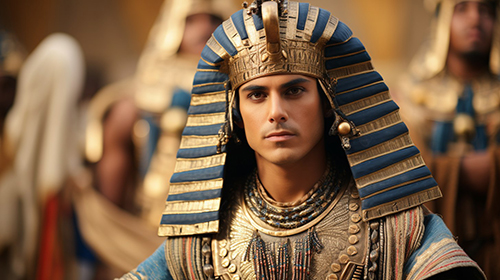 Hathor, protector of the pharaohs
Hathor is a kind and gentle goddess to both the living and the dead. She was especially favorable toward beautiful women, pregnant women, married couples, and newlyweds, and was regarded as their patroness. The goddess's name translates as "House of Horus," and her symbols are gold, turquoise, and jade.
Hathor was regarded as the mother, patroness, and protector of the pharaohs. For the Egyptians, she embodied everything feminine — beauty, sexuality, love, and motherly care. Devotion to her was so widespread that even some neighboring countries adopted Hathor as a deity of their own.
 Mistress of the Sky and Lady of the Stars
The Egyptians regarded all their female goddesses as other manifestations and forms of Hathor. She was also described as the wife and mother of many gods, and depending on the version of the myth, these relationships could vary considerably.
Hathor was called the "Mistress of the Sky" and the "Lady of the Stars." The sky was her dwelling place, home to the other gods as well. The Egyptians imagined the sky as a body of water, from which the creation of the world began, and pictured the goddess herself as the cow who gave birth to the sun. Moreover, like the goddess Nut, she gives birth to the sun anew each dawn, and then sails across the sky together with it.
According to one version, Hathor was simultaneously mother, wife, and daughter to Ra. At dawn, Hathor gives birth to Ra as his mother. Ra then creates Hathor from his own eye, as his daughter. He then takes her as his wife and impregnates her at sunset. The cycle repeats every day, meaning Ra is, in a sense, both his own father and his own son at once.
 The god Ra
The Eye of Ra protected the sun god from his enemies and was depicted as four cobras facing in different directions, allowing them to keep close watch and warn of danger. To her enemies, Hathor in the form of the Eye of Ra was merciless and dangerous. These two sides of the goddess — cruel and dangerous on one hand, charming and joyful on the other — reflected the Egyptian belief about women: that they could be overtaken by uncontrollable passion and fury, as well as by tender and beautiful love.
Hathor's charming and joyful side is reflected in her patronage of music, dance, festivity, and drinking. The Egyptians considered these pleasures of life to be gifts from the gods. During festivals, musicians played tambourines, harps, lyres, and sistrums. In fact, the sistrum instrument was considered one of her symbols and was used in rituals dedicated to Hathor.
These aspects of Hathor were tied to the myth of the Eye of Ra, in which she was stopped from destroying humanity with dyed beer. Because of this, during festivals, drinking, dancing, and music became ways of soothing her darker side. The Egyptians even said that the gods played the sistrum for her, and the goddesses danced for her, to chase away her foul mood.
Hathor's sexuality is described in various ways, from tender and innocent to unrestrained and bold. But she is always beautiful, attractive, and seductive. Interestingly, even gods with clearly established wives are sometimes depicted alongside Hathor in stories of a romantic nature. This isn't about infidelity so much as the idea that any goddess could take on Hathor's qualities and, in a sense, become her when it came to matters of love.
In one myth, the god Babi insulted Ra, leaving him so upset that he stopped fulfilling his duties, simply lying on his back and doing nothing. To cheer up her beloved, Hathor exposed her genitals to him. Ra smiled, forgot the insult, and returned to his duties.
 Isis
IsisAfter the New Kingdom, Hathor was gradually overshadowed by Isis, who took on some of her characteristics. Yet no other goddess had as many temples built in her honor throughout Egypt. Devotion to her, like that of other Egyptian gods, continued into the first centuries of our era.
Today, Hathor remains widely known in Egypt and beyond, primarily as a goddess of love, often associated with Aphrodite. But few know of her cruel and merciless side, one that terrifies even the gods. In this goddess, the Egyptians captured the image of ordinary women — beautiful, seductive, tender, and delicate, yet frightening, fierce, and unpredictable in anger.
Related Articles